


Inhabitat
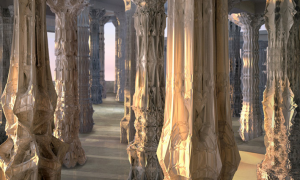
We’re big fans of cardboard architecture, but in most cases, the material yields structures that are boxy and rather simplistic. That’s why we were blown away when we spotted these incredibly intricate cardboard columns by Michael Hansmeyer, which FastcoDesign actually dubbed as the most complex architecture in the world. The dizzying Doric column variations are created on Hansmeyer’s computer using a subdivision algorithm that allows them to have between 8 and 16 million facets (distinct surfaces). They’re so insanely detailed that most people – including us – mistake the actual physical prototypes for computer renderings!
vía Insanely Intricate Cardboard Columns Have 16 Million Facets and Are the World’s Most Complex Architecture | Inhabitat – Green Design Will Save the World.
About cardboard architecture – encyclopedia.com
A Dictionary of Architecture and Landscape Architecture| 2000 | JAMES STEVENS CURL | 408 words | Copyrightcardboard architecture.
1. Design process using models to show formal and spatial relationships without taking into account the materials or functions of the final buildings.
2. Models with flat surfaces pierced by plain black holes resembling a series of cardboard boxes. The term in this sense has been used to describe the 1960s work of Kahn and others.
Bibliography Frampton et al. (1975); Sharp (1978)
Follow @arquitectonico






 Puzzle Bobble
 Karate Blazers
 Puzzle De Bloques
 Magical Cat Adventure