


(Scroll for English translation).
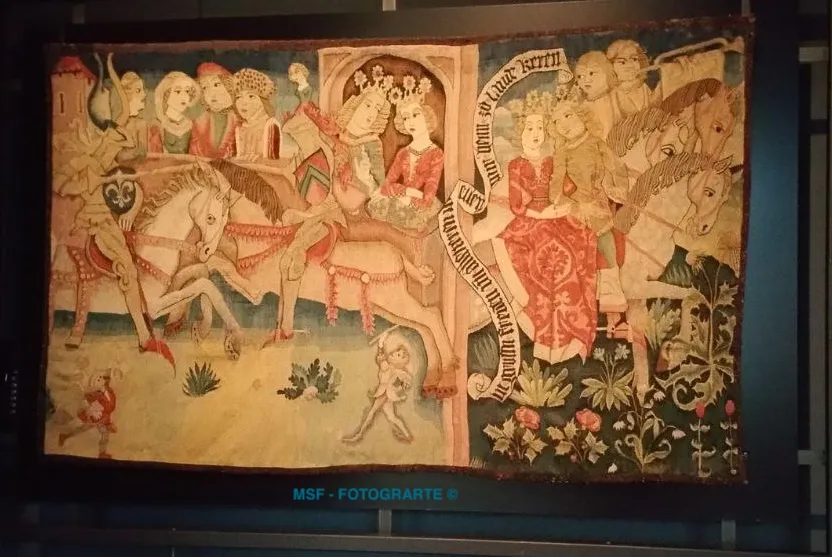
El Museo de Cluny o de la Edad Media (du Moyen Âge) tiene, entre sus tesoros, este tapiz que relata la historia de Busant o Busard (FR), un poema germánico alsaciano, de amor cortés, que narra las aventuras de una pareja principesca a las que un pájaro, el aguilucho, roba un anillo. Se divide en dos partes: muestra primero el torneo al que la pareja asiste junta tras su boda (FR) y luego su partida del lugar hacia su casa. Otros museos, entre los que se encuentra el Victoria y Alberto de Londres Les Cloîtres (MET) de Nueva York, y la Collection Burrel de Glasgow, conservan otros tapices que relatan otros episodios de la misma historia.
Más en profundidad (FR) podemos decir, que el poema fue escrito en el siglo XIV y narra la historia de amor de un príncipe francés que llega a París a estudiar y se enamora locamente de una princesa francesa. La rapta pero la abandona para buscar un anillo robado por un pájaro, lo que lo vuelve loco. Perdido, no encuentra a su prometida y enloquece de dolor. Vive en el bosque como un animal salvaje antes de ser encontrado e identificado por los cazadores. Al regresar a la corte francesa, es reconocido y puede casarse con la princesa.
La aristocracia de finales del momento seguía apegada al ideal caballeresco y disfrutaba relatando las epopeyas y los amores de la tradición cortesana.
El tapiz representa dos episodios felices de la Historia de Busant: la justa celebrada con motivo de la boda, a la izquierda, y el regreso a casa de la joven pareja, a la derecha. En el centro, un pórtico abovedado y una filacteria desenrollada dividen la narración en dos. Digamos que representa las dos últimas imágenes del poema:
a) la justa:
Dos caballeros se enfrentan en la liza ante una atenta fila de espectadores, listos para admirar la destreza de los justadores al derribar a su oponente con una lanza. Las dos figuras en primer plano son escuderos.
Sentados bajo el pórtico, los novios presencian el torneo organizado en su honor. Lucen sus mejores galas. La novia lleva un tocado conocido como «trufas» o «truffeaux». Las dos coronas recuerdan las coronas de flores de los novios.
b) la partida hacia su hogar:
A la derecha del escenario, los dos jóvenes, montados en el mismo caballo, abandonan la asamblea al son de las trompetas. Se puede admirar el ondulante vestido de la princesa.
La filacteria, en alsaciano antiguo, registra las palabras de la pareja:
in… grossn… freiden… un… allen… eren… wellen / wir… heim… zu… lande… keren
«Con gran alegría y con todo el homenaje, deseamos ahora regresar a casa.»
Los diseños y tejidos probablemente se realizaron en el valle del Rin, quizás en Estrasburgo. Se conservan algunos ejemplos de esta producción, repartidos por museos de todo el mundo (Colonia, Núremberg, Viena, Glasgow, Londres, Nueva York). Sin embargo, las diferencias de tamaño y calidad de ejecución sugieren que no todos los tapices pertenecen al mismo grupo. Por el contrario, se cree que varios talleres renanos trataron el tema. Esto demuestra la popularidad y el aprecio de la historia. Legado al Louvre en 1919 por el coleccionista Charles Lair, este tapiz ha estado en préstamo en el Museo Cluny desde 1986.
The Cluny Museum, or Museum of the Middle Ages (Musée du Moyen Âge), has among its treasures this tapestry that tells the story of Busant or Busard, a Germanic Alsatian poem of courtly love, which narrates the adventures of a princely couple from whom a bird, the eaglet, steals a ring. It is divided into two parts: first it shows the tournament the couple attends together after their wedding and then their departure to their home. Other museums, including the Victoria and Albert Museum in London, Les Cloîtres (MET) in New York, and the Burrel Collection in Glasgow, hold other tapestries that tell other episodes of the same story.
More in-depth, we can say that the poem was written in the 14th century and tells the love story of a French prince who arrives in Paris to study and falls madly in love with a French princess. He abducts her but abandons her to search for a ring stolen by a bird, which drives him mad. Lost, he cannot find his fiancée and goes mad with grief. He lives in the forest like a wild animal before being found and identified by hunters. Upon returning to the French court, he is recognized and is able to marry the princess.
The aristocracy of the late 19th century remained attached to the chivalric ideal and enjoyed recounting the epics and loves of courtly tradition.
The tapestry depicts two happy episodes from the History of Busant: the joust held on the occasion of the wedding, on the left, and the young couple’s return home, on the right. In the center, a vaulted portico and an unfurled phylactery divide the narrative in two. Let’s say it represents the last two images of the poem:
a) The joust:
Two knights face each other in the ring before an attentive line of spectators, ready to admire the jousters’ skill in knocking down their opponent with a lance. The two figures in the foreground are squires.
Seated beneath the portico, the bride and groom watch the tournament organized in their honor. They wear their best clothes. The bride wears a headdress known as a «truffle» or «truffeaux.» The two crowns resemble the bride and groom’s flower wreaths.
b) their departure for home:
To the right of the stage, the two young men, mounted on the same horse, leave the assembly to the sound of trumpets. The princess’s flowing dress can be admired.
The phylactery, in Old Alsatian, records the couple’s words:
in… grossn… freiden… un… allen… eren… wellen / wir… heim… zu… lande… keren
«With great joy and with all due homage, we now wish to return home.»
The designs and weavings were probably made in the Rhine Valley, perhaps in Strasbourg. A few examples of this production survive, scattered across museums around the world (Cologne, Nuremberg, Vienna, Glasgow, London, New York). However, differences in size and quality of workmanship suggest that not all tapestries belong to the same group. On the contrary, several Rhineland workshops are believed to have worked on the subject. This demonstrates the popularity and appreciation of the story. Bequeathed to the Louvre in 1919 by the collector Charles Lair, this tapestry has been on loan to the Cluny Museum since 1986.
Buy me a coffee. 







 Comecocos
 Karate Blazers
 Magical Cat Adventure
 Nostradamus