


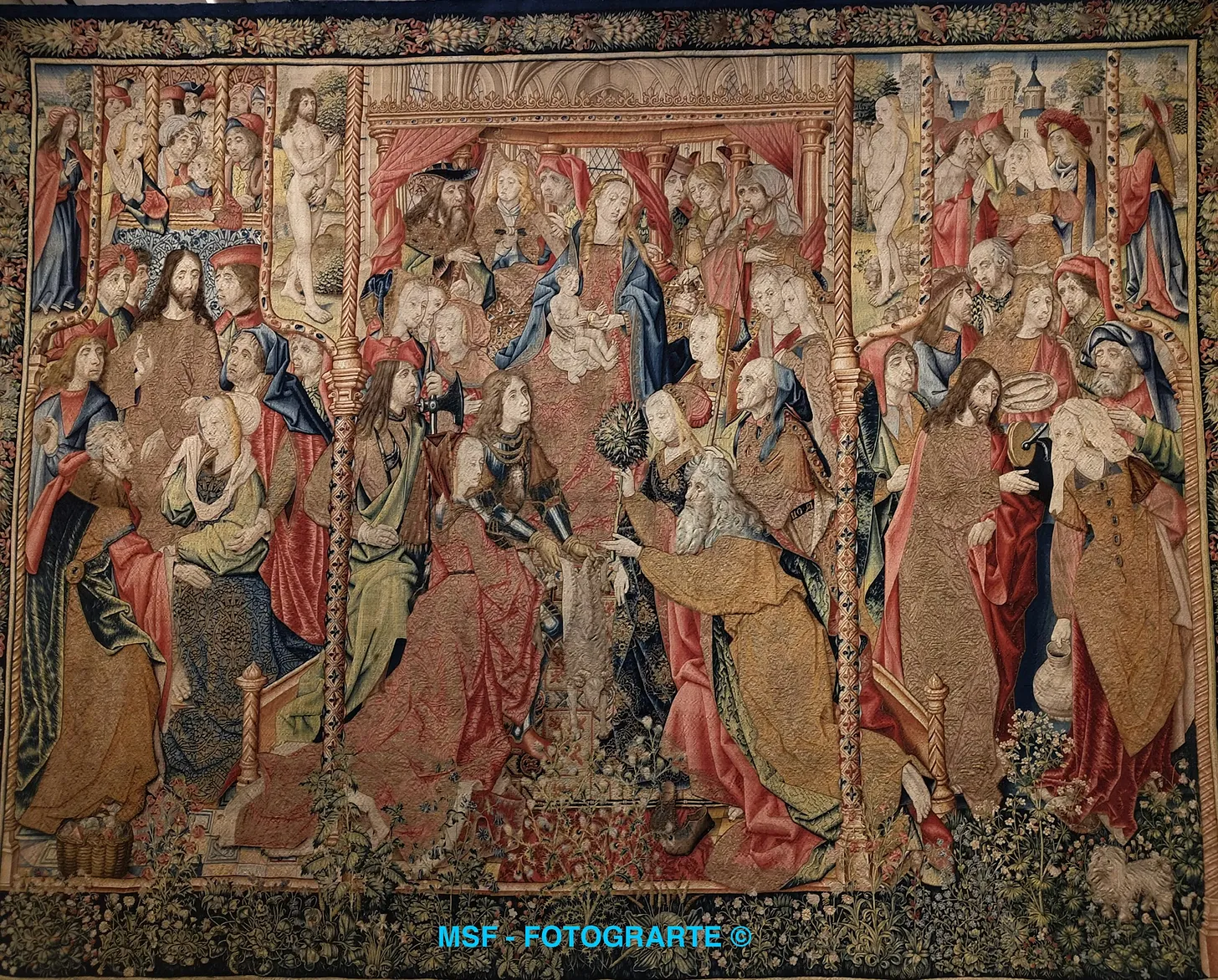
Tapiz en excepcional estado de conservación que perteneció a la Serie “Episodios de la Vida de la Virgen”. Hecho en Bruselas entre 1506 y 1507, está elaborado con hilo de oro, plata, seda y lana. Sus autores fueron Jan van Roome, cartonista, y Pieter Van Aelst, Tejedor.
Para que lo encajemos en el momento histórico, el 26 de noviembre de 1504 fallece Isabel la Católica, que deshereda a su hija por no confesarse ni ir a misa. Pero Fernando el Católico la proclama igual Reina de Castilla, aunque ni él ni Felipe el Hermoso, archiduque de Austria y duque de Borgoña como Felipe IV (de algunos de sus ascendientes ya hemos hablado en el blog: Felipe el Bueno y Carlos el Temerario), querían renunciar al poder. Así que Fernando y Felipe firman la Concordia de Salamanca y el segundo ordena volver en pleno invierno de 1505. Ello produce que la flota tenga que amarrar en Portland (entonces, Inglaterra, hoy Reino Unido), lo que aprovecha Juana para ver a su hermana Catalina, ya viuda del príncipe Arturo, pero aún sin casarse con el futuro Enrique VIII.
En abril de 1506, partieron de Inglaterra, desembarcando en La Coruña y obteniendo Felipe el apoyo de la nobleza castellana, por lo que Fernando el Católico firmó con él la concordia de Villafáfila (27 de junio de 1506) y se retiró a Aragón. Posteriormente, Felipe fue proclamado rey de Castilla con el nombre de Felipe I, que fallecerá en Valladolid el 25 de septiembre de dicho año.
Según la información del propio museo:
Este tapiz y otro más, relativos a la vida de la Virgen, fueron documentados en la colección de Juana I de Castilla a raíz del inventario de sus bienes redactado en 1509. Los dos presentan una disposición de tríptico, con elementos arquitectónicos góticos. El que nos ocupa muestra a María con el Niño, rodeados de ángeles con símbolos de la Pasión. Ante ellos, Gedeón mostrando el vellocino de oro (origen mítico de la Orden del Toisón de Oro) y Moisés con la zarza ardiente. Flanqueando esta escena, Cristo y la Samaritana y Jesús y la mujer adúltera. La estética de la cenefa remite al siglo XVI, aunque el gran número de personajes presentes es más propio del siglo anterior.
En el centro del tapiz podemos ver la planta llamada cardo mariano:
Hace referencia a la Virgen María, ya que hay una leyenda medieval sobre esta planta que dice que ella utilizó las grandes hojas de un cardo para ocultar a Jesús de los soldados de Herodes. Al momento de escapar, de su pecho cayeron algunas gotas de leche, que han perdurado para siempre en esta especie para recordar aquel señalado día. Este cardo quedó, entonces, bendecido y lleno de virtudes. Es por ello que en la medicina medieval se recomendaban esta planta a las puérperas y nodrizas, a fin de aumentar la secreción de leche. Por eso su nombre en muchos idiomas se refiere a la leche y a María.
Por tanto, como se está representando el Nacimiento de Jesús, se incluye esta planta en primer término.
Otros tapices relacionados: Nacimiento de Cristo.
Exceptionally well preserved tapestry, it belongs to the Series titled “Episodes from the Life of the Virgin”. Made in Brussels between 1505 and 1507, it’s made of gold, silver, Silk and wool. The authors are Jan Van Roome, cartoonist, and Pieter Van Aelst, Weaver.
To fit this into the historical moment, on November 26, 1504, Isabella the Catholic died, disinheriting her daughter for not confessing or going to mass. But Ferdinand the Catholic proclaimed her Queen of Castile, even though neither he nor Philip the Fair, Archduke of Austria and Duke of Burgundy with the name of Philip IV (we have already talked of some of his ancestors in the blog: Philip the Good and Charles the Bold), wanted to give up power.
So Ferdinand and Philip signed the Concord of Salamanca to share power and the latter pushed to travel to Castile in the middle of the winter the year after. This meant that the fleet had to dock in Portland (then England, today the United Kingdom), which let Joan see her sister Catherine, already widowed by Prince Arthur, but still not married to the future Henry VIII.
In April 1506, they left England, disembarking in La Coruña and obtaining the support of the Castilian nobility, so that Ferdinand the Catholic signed the Villafáfila concord with Philip (June 27, 1506) and retired to Aragon. Later, Philip was proclaimed king of Castile with the name of Philip I, who died in Valladolid on September 25 of that year.
According to the Gallery of the Royal Collections:
This tapestry and another one, relating to the life of the Virgin, were documented in the collection of Joanna I of Castile following the inventory of her assets drawn up in 1509. Both have a triptych layout, with Gothic architectural elements. This tapestry shows Mary with the Child, surrounded by angels with symbols of the Passion. Before them, Gideon showing the Golden Fleece (mythical origin of the Order of the Golden Fleece) and Moses with the burning bush. Flanking this scene, we can recognise Christ and the Samaritan woman and Jesus and the adulterous woman. The Style of the outer border was very popular in 16th century, although the large number of characters in the scenes is more typical of the previous century.
In the middle of the tapestry, we can see a plant called milk thistle:
It refers to the Virgin Mary, since there is a medieval legend about this plant that says that she used the large leaves of a thistle to hide Jesus from Herod’s soldiers. When he was escaping, a few drops of milk fell from her breast, which have remained forever in this species to remember that special day. This thistle was then blessed and full of virtues. That is the reason why in medieval medicine this plant was recommended to postpartum women and wet nurses, in order to increase the secretion of milk. That is why its name in many languages refers to milk and Mary.
That’s also why it’s included in a tapestry called «the Birth of the Son of God».







 Puzzle Bobble
 Karate Blazers
 Puzzle De Bloques
 Magical Cat Adventure