


Exploraremos una de las regiones más impactantes para la astronomía: el Llano de Chajnantor, hogar del Gran Conjunto Milimétrico/submilimétrico de Atacama (ALMA). Este observatorio, situado en uno de los lugares más secos y altos del planeta, nos ofrece una ventana privilegiada hacia el cosmos.
Ubicado a una altitud de 5000 metros en el desierto de Atacama, ALMA es uno de los proyectos astronómicos más ambiciosos de la historia. En las noches despejadas, sus 66 antenas captan señales de algunas de las estructuras más antiguas del universo. La vista panorámica del Llano de Chajnantor es impresionante: un horizonte dominado por antenas alineadas y un cielo repleto de objetos celestes conocidos y misteriosos.
El hecho de que Chile albergue este y otros observatorios astronómicos no es coincidencia. La combinación de baja humedad, altitud extrema y escasa contaminación lumínica hace que esta región sea ideal para la observación astronómica.
El conjunto ALMA es una red de radiotelescopios que trabajan en conjunto como un solo instrumento gigante. Las antenas de 12 metros de diámetro pueden moverse a lo largo de la llanura para modificar la resolución de sus observaciones. Un conjunto compacto de antenas más pequeñas de 7 metros complementa la estructura.
Aunque a simple vista parezca una instalación de ciencia ficción, ALMA es una maravilla de la ingeniería moderna, capaz de captar ondas milimétricas y submilimétricas provenientes del espacio profundo. Esto permite a los astrónomos estudiar desde las nubes de gas donde nacen estrellas hasta las estructuras de galaxias en el universo primitivo. Las noches en Chajnantor regalan un cielo estrellado que parece sacado de un sueño. En una imagen capturada por Babak Tafreshi, embajador fotográfico de ESO, se pueden identificar varios objetos astronómicos fascinantes:
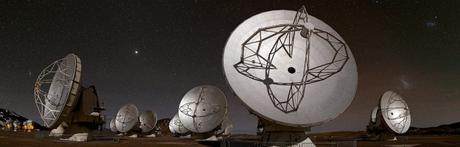
This panoramic view of the Chajnantor plateau, spanning about 180 degrees from north (on the left) to south (on the right) shows the antennas of the Atacama Large Millimeter/submillimeter Array (ALMA) ranged across the unearthly landscape. Some familiar celestial objects can be seen in the night sky behind them. These crystal-clear night skies explain why Chile is the home of not only ALMA, but also several other astronomical observatories. This image is just part of an even wider panorama of Chajnantor. In the foreground, the 12-metre diameter ALMA antennas are in action, working as one giant telescope, during the observatory’s first phase of scientific observations. On the far left, a cluster of smaller 7-metre antennas for ALMA’s compact array can be seen illuminated. The crescent Moon, although not visible in this image, casts stark shadows over all the antennas. In the sky above the antennas, the most prominent bright “star” — on the left of the image — is in fact the planet Jupiter. The gas giant is the third brightest natural object in the night sky, after the Moon and Venus. The Large and Small Magellanic Clouds can also be clearly seen on the right of the image. The Large Magellanic Cloud looks like a puff of smoke, just above the rightmost antenna. The Small Magellanic Cloud is higher in the sky, towards the upper-right corner. Both “clouds” are in fact dwarf irregular galaxies, orbiting the Milky Way galaxy, at distances of about 160 000 and 200 000 light-years respectively. On the far left of the panorama, just left of the foreground antennas, is the elongated smudge of the Andromeda galaxy. This galaxy, more than ten times further away than the Magellanic Clouds, is our closest major neighbouring galaxy. It is also the largest galaxy in the Local Group — the group of about 30 galaxies which includes our own — and contains approximately one trillion stars, more than twice as many as the Milky Way. It is the only major galaxy visible
" data-orig-size="1280,412" data-image-title="ALMA’s world at night" data-orig-file="https://josevicentediaz.com/wp-content/uploads/2025/03/potw1150a.jpg" data-image-description="" data-image-meta="{"aperture":"0","credit":"ESO\/B. Tafreshi (twanight.org)","camera":"","caption":"This panoramic view of the Chajnantor plateau, spanning about 180 degrees from north (on the left) to south (on the right) shows the antennas of the Atacama Large Millimeter\/submillimeter Array (ALMA) ranged across the unearthly landscape. Some familiar celestial objects can be seen in the night sky behind them. These crystal-clear night skies explain why Chile is the home of not only ALMA, but also several other astronomical observatories. This image is just part of an even wider panorama of Chajnantor. In the foreground, the 12-metre diameter ALMA antennas are in action, working as one giant telescope, during the observatory\u2019s first phase of scientific observations. On the far left, a cluster of smaller 7-metre antennas for ALMA\u2019s compact array can be seen illuminated. The crescent Moon, although not visible in this image, casts stark shadows over all the antennas. In the sky above the antennas, the most prominent bright \u201cstar\u201d \u2014 on the left of the image \u2014 is in fact the planet Jupiter. The gas giant is the third brightest natural object in the night sky, after the Moon and Venus. The Large and Small Magellanic Clouds can also be clearly seen on the right of the image. The Large Magellanic Cloud looks like a puff of smoke, just above the rightmost antenna. The Small Magellanic Cloud is higher in the sky, towards the upper-right corner. Both \u201cclouds\u201d are in fact dwarf irregular galaxies, orbiting the Milky Way galaxy, at distances of about 160\u00a0000 and 200\u00a0000 light-years respectively. On the far left of the panorama, just left of the foreground antennas, is the elongated smudge of the Andromeda galaxy. This galaxy, more than ten times further away than the Magellanic Clouds, is our closest major neighbouring galaxy. It is also the largest galaxy in the Local Group \u2014 the group of about 30 galaxies which includes our own \u2014 and contains approximately one trillion stars, more than twice as many as the Milky Way. It is the only major galaxy visible","created_timestamp":"1323684000","copyright":"","focal_length":"0","iso":"0","shutter_speed":"0","title":"ALMA's world at night","orientation":"0"}" width="1000" data-medium-file="https://josevicentediaz.com/wp-content/uploads/2025/03/potw1150a.jpg?w=300" data-permalink="https://josevicentediaz.com/2025/03/07/alma-secretos-y-curiosidades-del-universo-desde-el-desierto-de-atacama/almas-world-at-night/" alt="" height="321" class="wp-image-34824" data-large-file="https://josevicentediaz.com/wp-content/uploads/2025/03/potw1150a.jpg?w=1000" />Pulsar para ver detalles- Júpiter: El planeta gigante aparece como la «estrella» más brillante en la imagen. Es el tercer objeto natural más luminoso del cielo nocturno, después de la Luna y Venus.
- Las Nubes de Magallanes: A la derecha de la imagen, se distinguen la Gran y la Pequeña Nube de Magallanes, dos galaxias enanas irregulares que orbitan la Vía Láctea.
- Galaxia de Andrómeda: A la izquierda de las antenas se vislumbra esta majestuosa galaxia, nuestra vecina cósmica más grande. Con un trillón de estrellas, es más del doble del tamaño de la Vía Láctea y puede verse a simple vista bajo cielos oscuros.
El propósito de ALMA no es solo observar el cielo, sino entender los procesos fundamentales del universo. Algunas de sus investigaciones más relevantes incluyen:
- El estudio de discos protoplanetarios, donde nacen los planetas.
- La detección de moléculas complejas en el espacio, esenciales para la vida.
- La exploración de galaxias en el universo temprano, arrojando luz sobre su formación y evolución.
Gracias a su tecnología avanzada, ALMA ha permitido descubrir detalles antes invisibles, revolucionando nuestra comprensión del cosmos. ALMA es una colaboración internacional entre Europa, Norteamérica y Asia del Este, en cooperación con Chile. Su construcción y operación están lideradas por tres grandes instituciones:
- El Observatorio Europeo Austral (ESO)
- El Observatorio Nacional de Radioastronomía (NRAO)
- El Observatorio Astronómico Nacional de Japón (NAOJ)
La administración y operación conjunta garantizan que ALMA continúe proporcionando datos de vanguardia a la comunidad científica global.
Enlaces Recomendados
Si quieres profundizar más en estos temas, te dejamos algunos enlaces interesantes:
- Sitio oficial de ALMA
- Observatorio Europeo Austral (ESO)
- Imágenes astronómicas de Babak Tafreshi
- NASA: Descubrimientos recientes sobre exoplanetas
ALMA no solo nos acerca a los misterios del cosmos, sino que nos recuerda nuestra conexión con el universo. En cada noche despejada sobre Chajnantor, las antenas siguen escuchando los susurros del espacio, desvelando poco a poco el enigma de nuestro origen.
AnunciosDescubre más desde CURIOSIDADES ASTRONÓMICAS "Divulgación de la Astronomía"
Suscríbete y recibe las últimas entradas en tu correo electrónico.
Escribe tu correo electrónico…






 Puzzle Bobble
 Karate Blazers
 Puzzle De Bloques
 Magical Cat Adventure